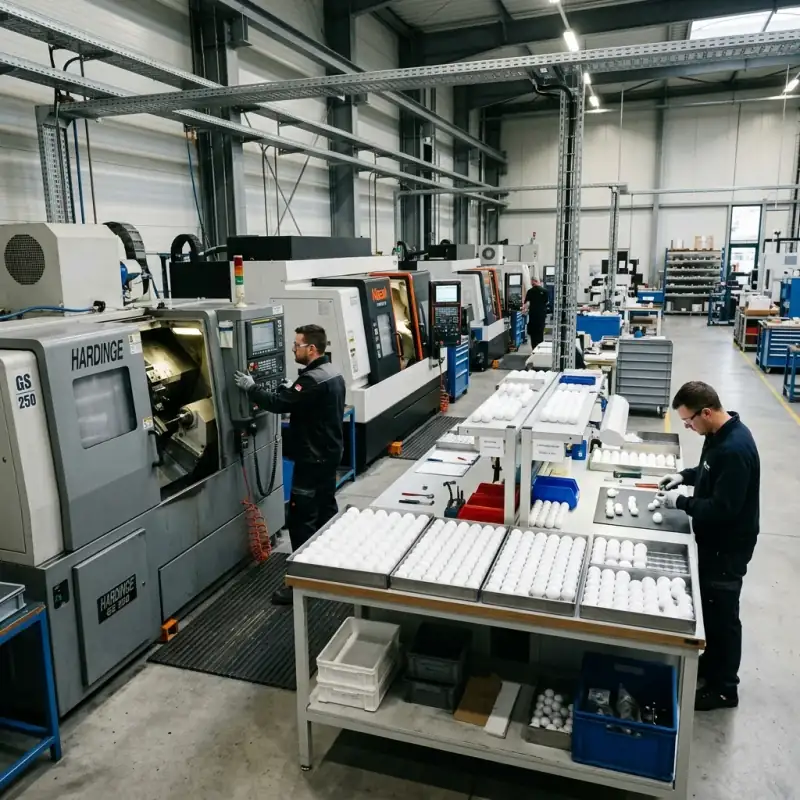
Summary:PTFE (polytetrafluoroethylene) is a fluoropolymer with a specific gravity of 2.14–2.20 g/cm³, a continuous service range of approximately -200°C to +260°C, a coefficient of friction of 0.04–0.10 (the lowest of any solid material), and near-universal chemical resistance. Its principal weaknesses are low compressive strength, significant cold flow under sustained load, high thermal expansion, and poor abrasion resistance — all of which are mechanical rather than chemical.
Quick Answer
PTFE (polytetrafluoroethylene) has a specific gravity of 2.14–2.20 g/cm³, a continuous service range of approximately -200°C to +260°C, a coefficient of friction of 0.04–0.10 — the lowest of any solid material — and resists effectively every industrial chemical. Its limitations are entirely mechanical: low compressive strength, significant cold flow under sustained load, high thermal expansion, and poor abrasion resistance.
Physical Properties
| Property | Typical value (virgin PTFE) | What it means in service |
|---|---|---|
| Specific gravity | 2.14–2.20 g/cm³ | Solid PTFE sinks in water. Density below this range indicates voids. |
| Water absorption | < 0.01% | No swelling, no dimensional change with humidity, indefinite storage. |
| Melting point | ~327°C | Well above service limit; relevant to the sintering cycle. |
| Continuous service temperature | -200°C to +260°C | Usable from cryogenic to high-temperature process duty. |
| Crystalline transition | ~19°C | Dimensions shift here — state measurement temperature on drawings. |
| Colour | Opaque white (virgin) | Filled grades are grey, black or bronze depending on filler. |
Mechanical Properties
| Property | Typical value | Practical consequence |
|---|---|---|
| Tensile strength | ~20–35 MPa | Modest. PTFE is not a structural material. |
| Elongation at break | 200–400% | Very ductile — deforms rather than fractures. |
| Compressive strength | ~12 MPa at 1% deformation | Low. This is what limits seat load in a check valve. |
| Hardness | Shore D 50–65 | Soft; scratches and embeds particles readily. |
| Coefficient of friction | 0.04–0.10 | Lowest of any solid. Static ≈ dynamic, so no stick-slip. |
| Deformation under load (creep) | Significant and continuous | The dominant service limitation for check balls. |
| Abrasion resistance | Poor | Wears quickly in particulate service — use filled grades or UHMWPE. |
Thermal Properties
| Property | Typical value | Practical consequence |
|---|---|---|
| Coefficient of thermal expansion | ~100–160 × 10⁻⁶ /°C | Roughly 10× steel. Fits must account for operating temperature. |
| Thermal conductivity | ~0.25 W/m·K | Poor conductor — heat builds up at friction contact points. |
| Upper decomposition threshold | > ~300°C | Degrades and releases hazardous products. Never exceed. |
| Flammability | UL94 V-0 | Does not support combustion. |
Electrical Properties
| Property | Typical value | Practical consequence |
|---|---|---|
| Dielectric strength | Very high | Excellent insulator, used in high-frequency applications. |
| Volume resistivity | > 10¹⁸ Ω·cm | Effectively non-conductive. |
| Dissipation factor | Extremely low | Minimal signal loss; stable across frequency. |
| Magnetic response | None | Non-magnetic — suits sensitive instrumentation and test rigs. |
Note: carbon-filled and bronze-filled PTFE are electrically conductive. If insulation matters, specify virgin explicitly.
Chemical Resistance
PTFE's chemical resistance comes from the carbon-fluorine bond, one of the strongest single bonds in organic chemistry, which shields the carbon backbone from attack. In practical terms PTFE is unaffected by:
- All mineral acids including sulphuric, hydrochloric, nitric, hydrofluoric and phosphoric, at all concentrations
- All alkalis including concentrated caustic soda and potash
- Organic solvents including chlorinated, aromatic and ketone solvents
- Halogens, oxidising agents, peroxides and bleaches
- Hydrocarbons, fuels, oils and refrigerants
- Steam and hot water
The known exceptions are narrow: molten alkali metals (sodium, potassium), elemental fluorine at elevated temperature and pressure, and certain fluorinating agents such as chlorine trifluoride. In normal industrial service you will exhaust PTFE's mechanical capability long before its chemical capability.
Where PTFE Actually Fails
Because the chemical resistance is so complete, buyers sometimes specify PTFE and then are surprised when it fails. It does fail — mechanically. The four modes, in order of frequency:
- Cold flow at the seat. Sustained seat load flattens the contact area until the ball stops sealing. The most common failure by a wide margin. Filled grades substantially delay it.
- Abrasive wear. Particulate in the media erodes the soft surface. UHMWPE or a filled PTFE grade usually outlasts virgin here.
- Thermal overrun. Sustained operation above 260°C degrades the polymer. There is no grade that fixes this — you need a different material.
- Internal voids. Not a material limitation but a manufacturing one: incomplete compaction or a wrong sintering ramp leaves cavities that fail under pressure. Density testing screens for it.
Diagnosing which one you have is usually straightforward from the worn part — a flattened contact area means cold flow, uniform surface erosion means abrasion, discolouration and embrittlement means thermal damage.
Related Reading
- What Is a PTFE Ball?
- Filled PTFE Balls — improving the mechanical numbers
- Common Failure Modes
- Grades & Tolerances
- PTFE Ball Glossary
PTFE Material Properties — FAQ
What is the density of PTFE?
Virgin PTFE has a specific gravity of 2.14 to 2.20 g/cm³. This is a useful quality check: a finished ball measurably below that range usually indicates internal voids or incomplete sintering, which is why density verification is part of our inspection routine.
What is PTFE’s coefficient of friction?
Between 0.04 and 0.10 depending on load and counterface — the lowest of any bulk solid material. Unusually, PTFE’s static and dynamic friction are nearly equal, which means it does not stick-slip. That is why it moves smoothly at very low velocities where other polymers judder.
What is cold flow in PTFE?
Cold flow, or creep, is PTFE’s tendency to deform permanently under sustained mechanical load even at ambient temperature. It is the single most important practical limitation for check balls: a ball held against a seat under pressure gradually develops a flat at the contact point and stops sealing. Filled grades reduce it substantially; no grade eliminates it.
Does PTFE absorb water?
Essentially no — water absorption is under 0.01%. That means PTFE balls do not swell, do not change dimension with humidity, and can be stored indefinitely without conditioning, unlike nylon which absorbs moisture and grows measurably.
What is the maximum temperature for PTFE?
Approximately +260°C for continuous service, with short excursions higher. Above roughly 300°C the polymer begins to degrade and can release hazardous decomposition products, so it should never be run there. At the other end, PTFE remains serviceable down to about -200°C, which is why it is used in cryogenic and LNG applications.
What chemicals attack PTFE?
Very few. PTFE resists effectively all acids, bases, solvents and oxidisers across its temperature range. The known exceptions are molten alkali metals, elemental fluorine at elevated temperature and pressure, and certain halogenated compounds under extreme conditions. In normal industrial service you are far more likely to run out of mechanical capability than chemical capability.
Is PTFE electrically insulating?
Yes. Virgin PTFE has a very high dielectric strength and extremely low dissipation factor, and is used as a high-frequency insulator. Note that carbon-filled and bronze-filled grades are electrically conductive, so if insulation matters you must specify virgin explicitly.
Request a PTFE Ball Quote
Tell us the ball diameter (5 mm to 310 mm), material grade, quantity, and application. In-house PTFE ball manufacturer & OEM — Dahegam, Gandhinagar, Gujarat, India.
- Response within 24 hours on business days
- MOQ flexible — samples and OEM volumes
- Engineering drawings accepted
- Export supply worldwide
- Metric and inch sizes from 5 mm to 310 mm
224/1, Nr. Precision Autowares, Nr. IOCL Petrol Pump, Zak-Vahelal Road, Dahegam
Gandhinagar, Gujarat 382305
India