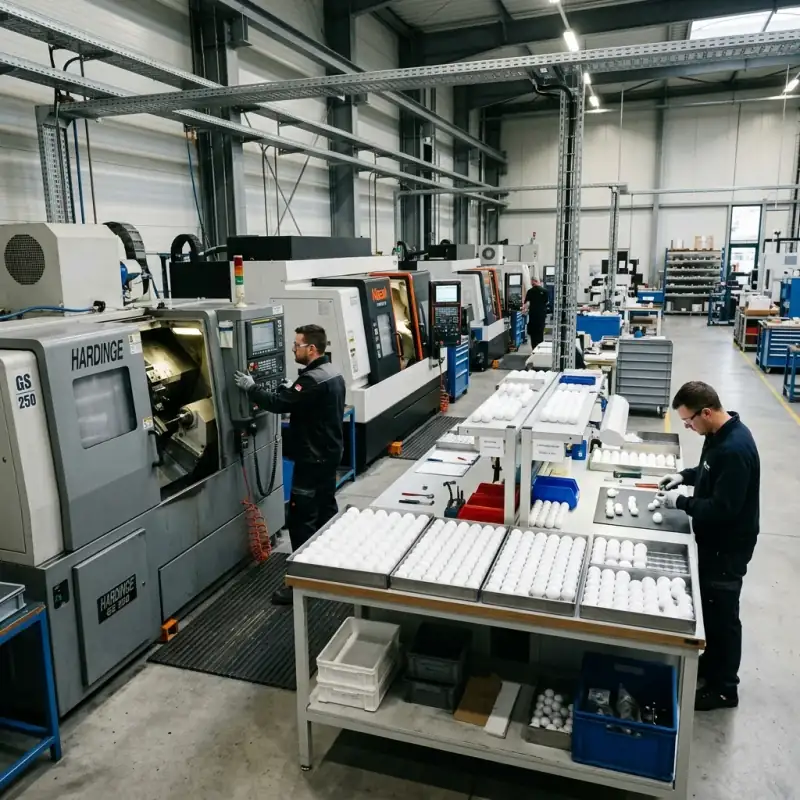
Summary:PTFE ball price is driven by five variables: diameter, resin grade, tolerance, quantity and whether tooling already exists. Diameter dominates because material volume scales with the cube of the radius — a 50 mm ball contains roughly 1,000 times the material of a 5 mm ball. Because pricing is specification-dependent, no honest supplier publishes a single price list; what you should compare is quotations against an identical, fully specified requirement.
Quick Answer
PTFE ball price is set by five variables: diameter, resin grade, tolerance, order quantity, and whether tooling already exists. Diameter dominates all of them, because a sphere's volume scales with the cube of its radius — a 50 mm ball contains roughly 1,000 times the material of a 5 mm ball. This is why no honest PTFE ball manufacturer publishes a flat price list, and why any supplier quoting you a figure before asking your diameter and quantity is guessing.
The Five Variables That Set the Price
1. Diameter — the dominant factor
Material cost scales with volume, and volume scales with the cube of the radius. Doubling the diameter multiplies material content by eight. Beyond raw material, large diameters are also disproportionately harder to make: compaction must be more carefully controlled to avoid density gradients, the sintering cycle is dramatically longer because heat has to reach the core without degrading the surface, and machining time increases. A 300 mm PTFE sphere is not sixty times harder to make than a 5 mm one — it is a fundamentally different manufacturing problem, and that is reflected in price.
2. Resin grade
Virgin PTFE resin costs more than reprocessed material, and filled compounds cost more again depending on filler type and loading. Bronze-filled grades carry the highest material cost of the common compounds. This is also where the largest quality gap between suppliers hides: two quotations described identically as "PTFE balls" may be virgin resin and reground material respectively, with a substantial price difference and a much larger difference in service life. Always ask which one you are being quoted.
3. Tolerance and finish
A tighter tolerance band means more grinding passes, more inspection and more rejected pieces. Both raise the cost per accepted ball. It also matters whether the ball is supplied as-molded, turned, or fully centerless ground — an as-molded ball is far cheaper and entirely adequate for some duties, while a check valve seat generally needs a ground finish. Comparing a ground ball's price against an as-molded one and concluding that one supplier is expensive is a common and costly mistake.
4. Quantity
Die setup, machine changeover and the sintering cycle are largely fixed costs per batch regardless of how many pieces are in it. Those costs divide across the order, so the per-piece price falls as quantity rises. The step change is usually between a sample quantity and a first production batch, rather than between a large order and a very large one — which means the biggest saving available to most buyers is consolidating scattered small orders into planned batches.
5. Tooling
A custom diameter needs a die fabricated before anything can be molded. That is a one-time cost quoted separately. Where the manufacturer retains the die — as we do — repeat orders of the same diameter never incur it again. For standard diameters where tooling already exists, there is no die cost at all, which is why standard sizes are so much cheaper for small quantities.
Why Quotes Vary So Widely
Buyers frequently receive quotations differing by a factor of five or ten for what they believe is the same item. Almost always, it is not the same item. The usual causes, in order of frequency:
- Resin grade differs. Reprocessed material quoted against virgin.
- Finishing differs. As-molded quoted against fully ground.
- Tolerance differs. One supplier quoting a loose commercial band, another quoting your drawing.
- Trading margins. The same factory's balls reaching you through two or three intermediaries.
- Incoterms differ. An EXW price compared against a CIF price is not a comparison at all.
The fix is straightforward: send every supplier an identical, fully specified RFQ, and require each quotation to state resin grade, tolerance, finishing method and Incoterm explicitly. Quotes that then still differ substantially are telling you something real.
How to Reduce Your PTFE Ball Cost
- Buy direct from the manufacturer. For most Indian and export buyers, trading margins are the single largest removable component of the delivered price.
- Consolidate orders. Batch setup costs are fixed; four orders a year cost more in setup than one planned annual release schedule.
- Specify a realistic tolerance. Tighter than the application needs costs money and buys nothing, particularly given PTFE's thermal expansion in service.
- Use a standard diameter where you can. Existing tooling removes the die cost entirely.
- Price on service life, not unit cost. A filled grade costing more per piece but lasting five times longer in a high-cycle pump is cheaper per operating hour and saves four maintenance interventions.
- Consolidate mixed sizes into one shipment. Especially for export, where freight is a real component of landed cost.
What to Send Us for a Firm Quotation
We quote firmly against a complete specification. Send:
- Diameter and tolerance (or a drawing — PDF, STEP or DXF)
- Resin grade: virgin, or filled and which filler and loading
- Quantity, and whether it repeats
- Application media, temperature and pressure
- Delivery location, and for export the discharge port and preferred Incoterm
If you have a worn ball from the existing application, send a photograph of it. The wear pattern tells us whether you actually need the grade you are currently buying — quite often it tells us you are overspending on virgin PTFE where a filled grade would last longer, or that you have been sold PTFE for a duty where cheaper UHMWPE would outlast it.
Related Reading
- How to Buy PTFE Balls — the full RFQ checklist
- PTFE Ball Selection Guide — choosing grade and diameter
- Filled PTFE Balls — when the premium grade is cheaper overall
- Choosing a PTFE Ball Manufacturer in India
- PTFE Ball Size Chart
PTFE Ball Price: What Drives the Cost — FAQ
How much does a PTFE ball cost?
It depends almost entirely on diameter and grade, and the range is enormous. A small standard-diameter virgin PTFE ball in production quantity is an inexpensive commodity item; a large custom-diameter sphere near 300 mm requiring dedicated tooling is a different order of cost entirely. Anyone quoting you a single figure without asking your diameter, grade, tolerance and quantity is not quoting seriously.
Is reprocessed PTFE cheaper?
Yes, noticeably — and that is exactly why unusually cheap quotes exist. Reprocessed or reground PTFE costs less as raw material but carries inconsistent density, higher void risk and unpredictable mechanical behaviour. For non-critical duty it may be acceptable. For a check valve in chemical service it is a false economy, and it is worth asking any supplier directly which one they are quoting.
Do I pay for the die separately?
For a custom diameter, yes — die fabrication is quoted separately and once. We retain the die afterward, so repeat orders of the same diameter do not incur it again. For standard diameters where tooling already exists, there is no die cost at all.
Why do PTFE ball quotes vary so much between suppliers?
Usually because the quotes are not for the same thing. Differences in resin grade (virgin versus reprocessed), tolerance band, whether the ball is ground or supplied as-molded, and how many trading margins sit in the chain all move the price substantially. Ask each supplier to state resin grade, tolerance and finishing method explicitly, and the comparison usually resolves itself.
Does ordering more reduce the price per ball?
Substantially, yes. Setup, die preparation and sintering cycle time are largely fixed per batch regardless of quantity, so those costs spread across more pieces. The step change is usually between a sample quantity and a first production batch rather than between large and very large orders.
How do I get an accurate PTFE ball quotation?
Send diameter, tolerance, resin grade (virgin or filled, and which filler), quantity, application media and temperature, and your destination. That is enough to quote firmly. Without diameter and quantity, any figure you receive is a guess.
Request a PTFE Ball Quote
Tell us the ball diameter (5 mm to 310 mm), material grade, quantity, and application. In-house PTFE ball manufacturer & OEM — Dahegam, Gandhinagar, Gujarat, India.
- Response within 24 hours on business days
- MOQ flexible — samples and OEM volumes
- Engineering drawings accepted
- Export supply worldwide
- Metric and inch sizes from 5 mm to 310 mm
224/1, Nr. Precision Autowares, Nr. IOCL Petrol Pump, Zak-Vahelal Road, Dahegam
Gandhinagar, Gujarat 382305
India