Product Overview
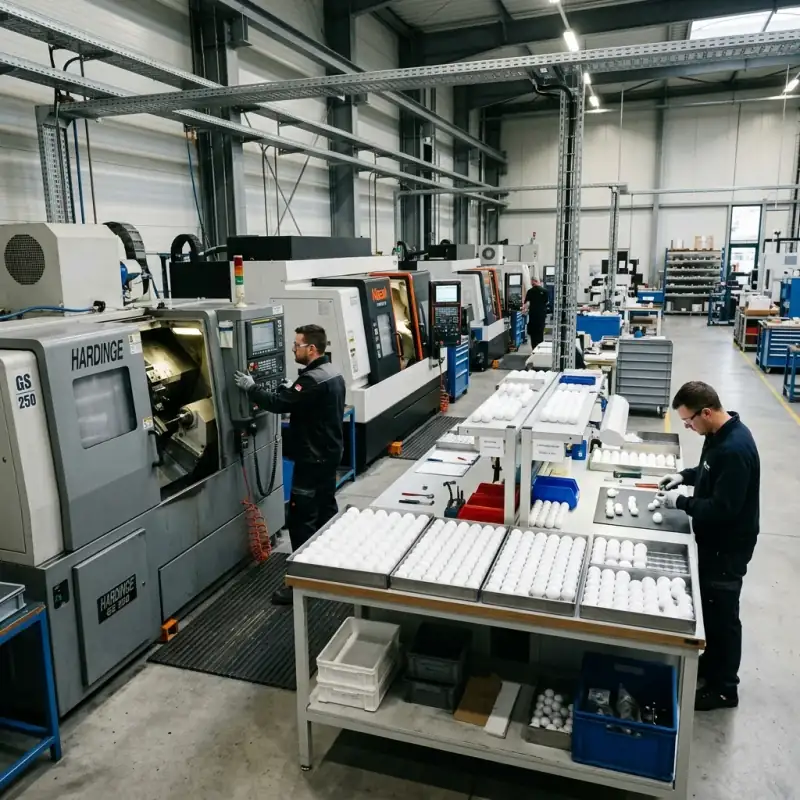
Filled PTFE balls are solid spheres molded from PTFE compounded with a reinforcing filler — most commonly glass fibre, carbon, bronze or graphite. The filler does not improve chemical resistance; virgin PTFE already resists almost everything. What it improves is mechanical behaviour: compressive strength roughly doubles, deformation under sustained load (cold flow) drops substantially, and wear rate can fall by an order of magnitude. That trade-off matters when a check ball is failing mechanically rather than chemically, which is the case in most high-cycle dosing pumps and high-pressure valve seats. We manufacture filled PTFE balls from 5 mm to 310 mm at our Gujarat plant, using the same compaction, sintering and centerless grinding route as our virgin grade.
Why Choose a Filled Grade
Lower cold flow
Filled grades resist creep under sustained seat load far better than virgin PTFE, so the ball keeps its sphericity and keeps sealing.
Higher wear resistance
Wear rate can drop by an order of magnitude versus virgin PTFE, which directly extends replacement intervals in high-cycle pumps.
Greater compressive strength
Roughly double that of virgin PTFE, allowing higher seat loads and system pressures without permanent deformation.
Better dimensional stability
Lower thermal expansion means the ball holds its fit across a wider operating temperature swing.
Improved thermal conductivity
Bronze and carbon grades conduct heat away from the contact zone instead of letting it build up.
Same chemical breadth
Filler choice must suit the media — but the PTFE matrix keeps the chemical resistance that made you specify PTFE in the first place.
Filled PTFE Ball Sizes
Filled grades are available across our full diameter range. Note that filled PTFE grinds to a slightly different surface character than virgin — tell us your tolerance and finish requirement and we will confirm against your specific diameter rather than quote a generic band.
| Nominal Size | Metric (mm) | Inch Equivalent | Tolerance |
|---|---|---|---|
| 1/4" | 6.35 mm | 0.250" | ± 0.05 mm |
| 3/8" | 9.525 mm | 0.375" | ± 0.05 mm |
| 1/2" | 12.70 mm | 0.500" | ± 0.05 mm |
| 3/4" | 19.05 mm | 0.750" | ± 0.08 mm |
| 1" | 25.40 mm | 1.000" | ± 0.10 mm |
| 2" | 50.80 mm | 2.000" | ± 0.15 mm |
| 4" | 101.60 mm | 4.000" | ± 0.25 mm |
| Large | up to 310 mm | up to 12.2" | To drawing |
How Filled PTFE Balls Are Made
Filler and PTFE resin are blended to the specified loading — typically 15% or 25% glass, 25% carbon, or 40% to 60% bronze by weight. Blend uniformity matters: an uneven distribution creates weak zones that fail early in service.
The compound is compacted in a die under controlled pressure. Filled compounds flow differently from virgin resin, so compaction pressure and dwell are adjusted per grade to avoid density gradients.
The preform is sintered on a controlled heating and cooling ramp. Filled grades are more sensitive to thermal shock than virgin PTFE, so the cooling ramp is slower to prevent internal cracking around filler particles.
Sintered blanks are turned to near-net sphere, then centerless ground. Filled grades are more abrasive on tooling, so cutting parameters and wheel selection differ from the virgin route.
Every batch is checked for diameter, roundness and surface condition, with density verification confirming correct filler loading and void-free consolidation.
Where Filled PTFE Balls Are Used
Filled grades belong wherever the failure mode is mechanical — wear, creep or deformation — rather than chemical attack. If your virgin PTFE balls are coming out chemically intact but flattened, scored or out of round, a filled grade is the answer.
High-cycle dosing pumps
Metering pumps that cycle continuously flatten a virgin PTFE ball at the seat contact area. Glass-filled grades hold sphericity far longer under that repeated load.
High-pressure check valves
Where seat load would permanently deform virgin PTFE, filled grades carry the compressive stress without cold-flowing into the seat.
Abrasive slurry service
Carbon and glass-filled grades resist particle abrasion that erodes virgin PTFE, extending life in mineral, pigment and slurry dosing lines.
Elevated temperature duty
Filled PTFE holds dimensional stability better as temperature rises, so the ball-to-seat fit stays predictable across a wider operating window.
Bearing and sliding contact
Bronze and graphite-filled grades conduct heat away from the contact zone and reduce wear in sliding or rotating sphere applications.
Oilfield chemical injection
Continuous-duty injection pumps benefit from the extended wear life of filled grades where downtime for ball replacement is expensive.
Why Choose Hemsun Engg. Industries?
We compound, mold, sinter and grind filled PTFE balls in our own plant, which matters more for filled grades than for virgin. Filler loading, blend uniformity and the sintering cooling ramp all change the finished ball’s behaviour, and none of those are visible in a purchase order — a trader cannot tell you what they were. We can, because we set them. If you are unsure whether your application actually needs a filled grade, send us a worn ball; the wear pattern usually tells us straight away whether the problem is chemistry, cold flow or abrasion.
35+ Years Experience
Manufacturing precision polymer spheres in India since 1990.
Direct OEM Supply
Complete in-house molding, sintering, and centerless grinding control.
100% Quality Audited
Full roundness, surface finish, and void-free inspection checks.
Custom Machining
Die fabrication to drawings for specialized diameters and features.
Filled PTFE Grades Compared
Choosing the filler is the whole decision. Each one trades something away — this table is what actually differs in service.
| Technical Property | This Product (Filled PTFE Balls) | Alternative / Alternatives |
|---|---|---|
| Glass-filled (15–25%) | Best general-purpose upgrade. Large reduction in cold flow and wear, good compressive strength. | Avoid in hydrofluoric acid and strong caustic — these attack the glass filler even though PTFE resists them. |
| Carbon-filled (25%) | Excellent wear resistance and thermal conductivity. Chemically resistant across almost the full PTFE range. | Electrically conductive, so unsuitable where insulation is required. Black colour only. |
| Bronze-filled (40–60%) | Highest wear resistance and thermal conductivity, best load-bearing capability of the common grades. | Not for chemical service — bronze corrodes in acids and is unsuitable for food, pharmaceutical or potable water contact. |
| Graphite-filled | Lowest friction of the filled grades, good for sliding contact and non-lubricated movement. | Lower compressive strength than glass or bronze grades. Electrically conductive. |
| Virgin PTFE (no filler) | Widest chemical resistance, non-leaching, FDA-compliant resin available, electrically insulating. | Lowest wear resistance and highest cold flow — it deforms under sustained seat load. |
Filled PTFE Balls — FAQ
When should I use filled PTFE instead of virgin PTFE?
When the failure mode is mechanical rather than chemical. If your virgin PTFE balls come out of service chemically undamaged but flattened at the seat contact, scored or out of round, the problem is cold flow or wear and a filled grade will last considerably longer. If they come out swollen, cracked or chemically attacked, a filler will not help — you need a different polymer.
Can filled PTFE balls be used in food or pharmaceutical applications?
Generally no, and this is important. Filled grades contain particles that can shed into the product stream, so regulated food, beverage, pharmaceutical and potable water applications specify virgin PTFE instead — accepting shorter wear life in exchange for purity. Bronze-filled grades are definitively unsuitable for contact service.
Which filled grade should I choose?
Glass-filled 25% is the usual starting point for general high-cycle valve and pump duty. Choose carbon-filled where you need better thermal conductivity and broader chemical compatibility than glass allows. Choose bronze-filled only for demanding mechanical duty in non-corrosive, non-contact service. Tell us the media, temperature, pressure and cycle rate and we will recommend rather than upsell.
Can you supply filled PTFE balls to a custom diameter?
Yes. We fabricate dies in-house, so custom diameters from 5 mm to 310 mm are routine in filled grades as well as virgin. Send a drawing with diameter, tolerance, filler type and loading.
Does adding a filler improve chemical resistance?
No — it usually reduces it. Virgin PTFE already resists nearly every industrial chemical. Adding glass, carbon or bronze introduces a material that can be attacked even when the PTFE matrix is not. Glass-filled grades in particular should not be used in hydrofluoric acid or strong caustic, and bronze-filled grades are unsuitable for most acid service.
What is cold flow, and why does it matter for check balls?
Cold flow (creep) is PTFE’s tendency to deform permanently under sustained mechanical load, even at room temperature. In a check valve, the ball is pressed against its seat continuously, so over time a flat develops at the contact point and the ball stops sealing. Fillers restrain the polymer chains and reduce this substantially — it is the single most common reason to move from virgin to filled grade.
Are filled PTFE balls more expensive than virgin?
Per piece, usually yes. In service, often not — if a filled ball lasts five times longer in a high-cycle pump, the cost per operating hour is lower and you avoid four maintenance interventions. Price the change on replacement interval, not on unit cost.
Request a Filled PTFE Ball Quote
Tell us the ball diameter (5 mm to 310 mm), material grade, quantity, and application. In-house PTFE ball manufacturer & OEM — Dahegam, Gandhinagar, Gujarat, India.
- Response within 24 hours on business days
- MOQ flexible — samples and OEM volumes
- Engineering drawings accepted
- Export supply worldwide
- Metric and inch sizes from 5 mm to 310 mm
224/1, Nr. Precision Autowares, Nr. IOCL Petrol Pump, Zak-Vahelal Road, Dahegam
Gandhinagar, Gujarat 382305
India