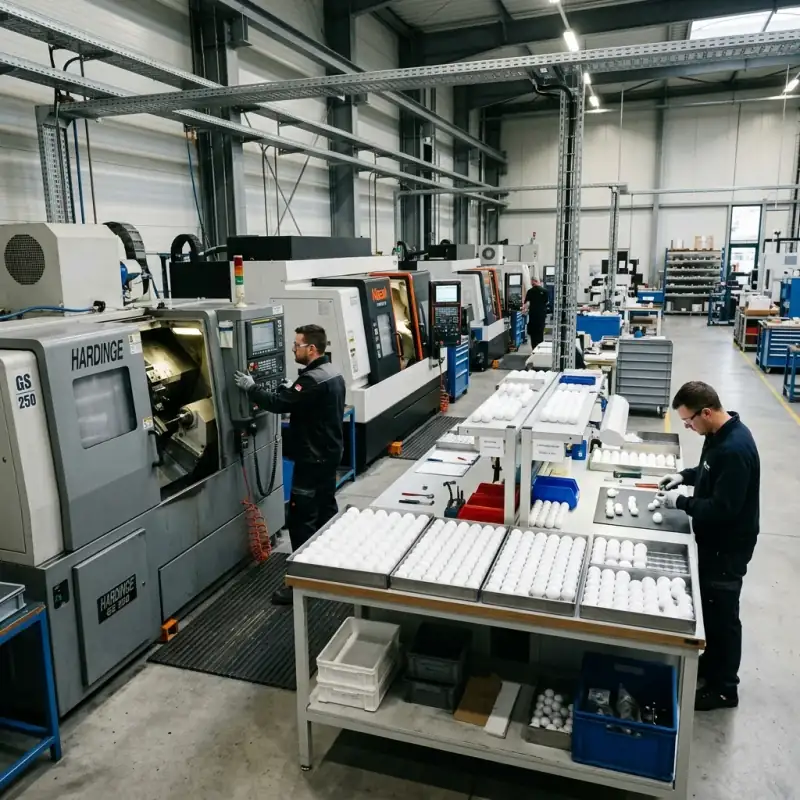
Summary:PTFE balls are solid fluoropolymer spheres valued for chemical inertness, low friction, and wide temperature range. This guide covers structure, properties, limitations, and typical valve and pump uses.
Quick Answer
A PTFE ball is a solid sphere made from polytetrafluoroethylene (PTFE/Teflon™) — a fluoropolymer valued for universal chemical resistance, low friction (0.04–0.10), and operation from -200°C to +260°C. They are used as check valve elements, pump internals, and flow indicators — not as the large shutoff ball in a floating ball valve.
Introduction to Polytetrafluoroethylene (PTFE) Spheres
A PTFE ball is a solid sphere made from Polytetrafluoroethylene (PTFE), a synthetic fluoropolymer of tetrafluoroethylene. Commonly used as a check valve closure, dosing pump float, or fluid sealing element, solid PTFE spheres are engineered for extreme chemical inertness, a wide temperature range of -200°C to +260°C, and a very low coefficient of friction. This guide explores the material chemistry, key physical parameters, and mechanical behaviors that make solid PTFE spheres (such as Virgin PTFE Balls) critical components in engineering applications, particularly in fluid handling, chemical processing, and industrial valves. For lightweight float applications, we also manufacture PTFE hollow balls from two hemispheres joined by thermal fusion and chemical welding.
Chemical Structure and Inertness
The primary driver behind the popularity of PTFE is its molecular structure. The polymer chain consists entirely of carbon and fluorine atoms, with the carbon-fluorine (C-F) bond being one of the strongest single bonds in organic chemistry. This strong atomic bond creates a protective envelope around the carbon backbone, rendering the material almost entirely inert to external chemical attacks.
PTFE balls are unaffected by strong acids (such as sulfuric acid, hydrochloric acid, and nitric acid), concentrated bases, organic solvents, halogens, and corrosive hydrocarbons. The only substances known to degrade or react with PTFE under normal conditions are molten alkali metals, gaseous fluorine at elevated temperatures, and certain specialized halogenated compounds. For chemical process engineers, this means solid PTFE spheres can be deployed in highly corrosive environments without risk of corrosion, leaching, or structural degradation.
Key Physical and Thermal Properties
Solid PTFE spheres exhibit a distinct combination of physical properties that distinguish them from standard engineering plastics:
- High Density: Pure virgin PTFE has a specific gravity ranging from 2.14 to 2.20 g/cm³, making it one of the densest engineering polymers available.
- Low Coefficient of Friction: PTFE features a self-lubricating surface with an extremely low static and dynamic coefficient of friction (typically 0.04 to 0.10 against steel). This prevents stiction and ensures smooth operation in moving valve assemblies.
- Extreme Temperature Resistance: PTFE balls maintain their physical integrity and mechanical flexibility across a broad temperature spectrum, from cryogenic environments at -200°C up to continuous service temperatures of +260°C (+500°F).
- Zero Moisture Absorption: According to ASTM D570 testing, PTFE has a water absorption rate of 0.00%. This ensures absolute dimensional stability in aqueous fluids, steam, and humid environments.
- Electrical Insulation: With a high dielectric strength and low dissipation factor, PTFE is an outstanding electrical insulator.
Mechanical Performance and Limitations
While PTFE offers unmatched chemical and thermal resistance, designers must account for its mechanical limitations. PTFE is a relatively soft polymer with a Shore D hardness rating between 50 and 65. It exhibits lower tensile strength and load-bearing capacity compared to crystalline engineering plastics like Delrin (POM) or PEEK.
Under continuous compressive load, PTFE is subject to "cold flow" or creep—a slow, progressive deformation. In check valve designs, this cold flow can actually be advantageous, as it allows the ball to slightly conform to the valve seat, creating a highly effective, leak-free seal at low pressures. However, in high-pressure systems, the ball can extrude through the seat if the seat orifice is too wide or if the system pressure exceeds the material's yield point. To counter this, design engineers specify tight tolerances, reinforce the seat structure, or compound the PTFE with fillers such as glass fiber, carbon, or bronze (see Custom PTFE Balls) to improve load capacity and reduce creep.
Common Industrial Applications
Solid PTFE spheres are critical components in several high-performance industries (read more in our PTFE Ball Applications guide):
- Industrial Check Valves: PTFE balls act as the moving closure element in ball check valves, allowing unidirectional fluid flow while preventing backflow of aggressive process chemicals.
- Diaphragm Pumps: In air-operated double diaphragm (AODD) pumps, PTFE spheres function as intake and discharge check valves, cycling rapidly to maintain pump suction and pressure.
- Instrumentation and Flowmeters: Due to their uniform density and low friction, smaller PTFE spheres are used as indicator floats in rotameters and flow monitoring equipment.
- Food and Pharmaceutical Systems: Pure, unfilled virgin PTFE is inherently non-toxic, non-contaminating, and complies fully with FDA regulations, making it safe for sanitary beverage lines, dairy processing, and active pharmaceutical ingredient (API) handling.
Material Specifications Comparison
| Property | Test Method | Typical Value |
|---|---|---|
| Specific Gravity | ASTM D792 | 2.14 - 2.20 g/cm³ |
| Tensile Strength | ASTM D638 | 20 - 35 MPa |
| Elongation at Break | ASTM D638 | 250% - 350% |
| Shore D Hardness | ASTM D2240 | 50 - 65 |
| Max Operating Temp | Continuous | +260°C |
| Coefficient of Friction | Dynamic | 0.04 - 0.10 |
What Is a PTFE Ball? — FAQ
What is PTFE made of?
PTFE (polytetrafluoroethylene) is a fluoropolymer built from carbon and fluorine atoms. The strong carbon-fluorine bond gives the material its chemical inertness and low friction.
Can PTFE balls handle high temperatures?
Yes. Virgin PTFE operates from approximately -200°C to +260°C continuous service, making it suitable for cryogenic and elevated-temperature fluid systems.
What is the density of a solid PTFE ball?
Virgin PTFE has a specific gravity of 2.14 to 2.20 g/cm³. Density verification is part of our in-house QC to confirm void-free molding.
Where are PTFE balls most commonly used?
Check valves, diaphragm pumps, chemical process piping, food and beverage lines, and flow instrumentation. See our applications guide for detail.
Request a PTFE Ball Quote
Tell us the ball diameter (5 mm to 310 mm), material grade, quantity, and application. In-house PTFE ball manufacturer & OEM — Dahegam, Gandhinagar, Gujarat, India.
- Response within 24 hours on business days
- MOQ flexible — samples and OEM volumes
- Engineering drawings accepted
- Export supply worldwide
- Metric and inch sizes from 5 mm to 310 mm
224/1, Nr. Precision Autowares, Nr. IOCL Petrol Pump, Zak-Vahelal Road, Dahegam
Gandhinagar, Gujarat 382305
India