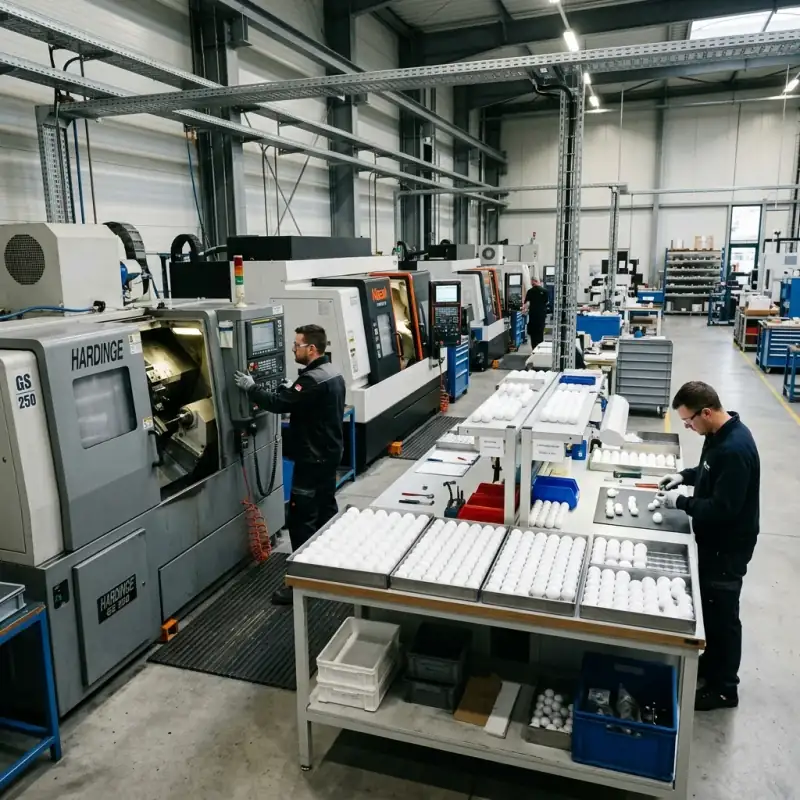
Summary:This glossary defines the terminology used across PTFE ball specification, manufacturing and application — from material terms like virgin resin, sintering and cold flow, through geometry terms like sphericity and diameter tolerance, to application terms like soft seat, AODD pump and check valve. Each definition is written to stand alone.
Quick Answer
This glossary defines every term you are likely to meet on a PTFE ball drawing, quotation or datasheet. It covers 28 terms across material science, manufacturing process, ball geometry, application context and commercial vocabulary. Each definition stands alone.
Jump to: Material · Manufacturing · Geometry · Application · Commercial
Material Terms
- PTFE
- Polytetrafluoroethylene — a fluoropolymer built entirely from carbon and fluorine atoms. The carbon-fluorine bond is one of the strongest in organic chemistry, which gives PTFE near-universal chemical resistance, the lowest coefficient of friction of any solid material, and a service range of roughly -200°C to +260°C.
- Teflon
- A registered trade name for PTFE, originally owned by DuPont and now held by Chemours. Teflon and PTFE are the same polymer; the difference is legal, not chemical. Any manufacturer can produce PTFE, but only the brand owner can call it Teflon.
- Virgin PTFE
- PTFE molded from new, unused resin containing no reprocessed material and no fillers. It gives the most consistent density, the widest chemical resistance and a clean material declaration, which is why food, pharmaceutical and potable water applications specify it.
- Reprocessed PTFE
- PTFE containing reground or recycled material. It is cheaper than virgin resin but has less consistent density, higher void risk and less predictable mechanical behaviour. It is a common reason for unusually low quotations and should always be asked about explicitly.
- Filled PTFE
- PTFE compounded with a reinforcing filler — commonly glass fibre, carbon, bronze or graphite. Fillers improve compressive strength, wear resistance and cold flow behaviour, but reduce chemical resistance and make the material unsuitable for food and pharmaceutical contact service.
- Glass-filled PTFE
- PTFE compounded with glass fibre, typically at 15% or 25% by weight. The most common filled grade, giving a large reduction in cold flow and wear at moderate cost. It should not be used in hydrofluoric acid or strong caustic, which attack the glass filler even though PTFE itself resists them.
- Carbon-filled PTFE
- PTFE compounded with carbon, typically at 25% by weight. Offers excellent wear resistance and improved thermal conductivity while retaining broad chemical resistance. It is electrically conductive, so it cannot be used where electrical insulation is required.
- Bronze-filled PTFE
- PTFE compounded with bronze powder, typically at 40% to 60% by weight. Gives the highest wear resistance, load capability and thermal conductivity of the common filled grades, but the bronze corrodes in acid service and rules the material out of food, pharmaceutical and potable water contact.
- Cold flow (creep)
- PTFE’s tendency to deform permanently under sustained mechanical load, even at ambient temperature. In a check valve, continuous seat pressure gradually flattens the ball at the contact point until it stops sealing. Cold flow is the single most common practical limit on PTFE ball service life; filled grades reduce it substantially but no grade eliminates it.
Manufacturing Terms
- Sintering
- The controlled heating stage that converts a compacted PTFE powder preform into a solid part. PTFE cannot be injection molded because its melt viscosity is far too high, so it is compacted cold then heated above its crystalline melting point so particles coalesce. Heating and cooling ramp rates determine final density, void content and mechanical properties.
- Compression molding
- The forming stage in which PTFE powder is compacted in a die under controlled pressure to produce a green preform before sintering. Compaction pressure and dwell time govern density uniformity; uneven compaction produces internal voids that surface later as premature ball failure.
- Centerless grinding
- The finishing process that brings a turned sphere to final diameter, roundness and surface finish. The ball is ground between a rotating wheel and a regulating wheel without being held on centres, which is what makes consistent sphericity achievable in production quantities.
- Void
- An internal cavity or porosity in a molded PTFE ball, caused by incomplete compaction or an incorrect sintering cycle. Voids weaken the ball, can trap process fluid, and cause sudden failure under pressure. Density testing against the 2.14–2.20 g/cm³ range is the standard non-destructive screen for them.
Geometry Terms
- Sphericity (roundness)
- How closely a ball approaches a perfect sphere, measured as the maximum radial deviation from a true spherical form. For check valve duty sphericity usually matters more than absolute diameter accuracy, because sealing depends on consistent contact all the way around the seat.
- Diameter tolerance
- The permitted deviation of a ball’s measured diameter from its nominal size, expressed as a plus/minus band. It is independent of sphericity — a ball can be exactly nominal diameter and still be out of round. PTFE tolerance specifications should state the measurement temperature, because PTFE expands roughly ten times as much as steel.
- Ball grade (G-number)
- A sphericity classification from precision bearing ball standards, where the number is the maximum deviation from a perfect sphere in hundred-thousandths of an inch — Grade 25 means 0.000025 inch. These grades were developed for hardened steel and are not realistically achievable in PTFE, which is soft and thermally expansive.
- Surface roughness (Ra)
- The average deviation of a surface profile from its mean line, expressed in micrometres. On a check ball, a rougher surface leaves leak paths at the seat contact line. PTFE also burnishes during the first hours of service, so the in-service finish differs from the as-supplied finish.
Application Terms
- Check valve
- A valve that permits flow in one direction only. In a ball check valve, a free-moving sphere is pushed off its seat by forward flow and pressed back onto it by reverse flow. The ball is the sealing element, which is why its roundness and surface condition determine the valve’s performance.
- Soft seat
- A valve seat design in which a comparatively soft sealing element — such as a PTFE ball — deforms slightly against a harder seat to close the leak path. Soft-seat designs seal better at low pressure than metal-to-metal seats but are limited by the soft element’s creep resistance.
- AODD pump
- Air-Operated Double Diaphragm pump — a positive displacement pump using compressed air to drive two diaphragms, with check balls controlling flow direction at the inlet and outlet of each chamber. AODD pumps are among the highest-volume users of PTFE check balls because they handle aggressive chemistry at high cycle rates.
- Dosing pump
- A positive displacement pump that delivers a precisely metered volume per stroke, using check balls to control flow direction. Because dosing pumps cycle continuously, their check balls are treated as scheduled consumables rather than permanent components.
- Hollow PTFE ball
- A buoyant PTFE sphere produced by joining two machined hemispheres through thermal fusion and chemical welding. Solid PTFE sinks at 2.14–2.20 g/cm³, so hollow construction is how float and level-indication applications get buoyancy while keeping full PTFE chemical resistance.
- Float ball
- A buoyant sphere used to indicate or control liquid level, in a sight glass, rotameter, level switch or tank float valve. Material choice depends on required density: polypropylene floats naturally, while PTFE must be made hollow to float.
Commercial Terms
- MOQ
- Minimum Order Quantity — the smallest quantity a manufacturer will produce economically. For polymer balls the MOQ is driven by die setup and sintering cycle time rather than material cost, which is why the per-piece price drops sharply between a sample quantity and a first production batch.
- Die
- The tooling used to compact PTFE powder into a preform of a given diameter. A custom diameter requires a die to be fabricated, quoted once and separately. A manufacturer that retains your die can run repeat orders to identical geometry without re-tooling.
- RFQ
- Request For Quotation. For PTFE balls a complete RFQ states diameter, tolerance, resin grade, quantity, application media, temperature and destination. Missing diameter or quantity makes any resulting figure a guess rather than a quotation.
- Incoterms
- Standardised international trade terms defining where responsibility for cost, risk and delivery passes from seller to buyer — EXW, FOB, CFR and CIF being the common ones for export ball shipments. Quotations are not comparable unless they are on the same Incoterm.
- Material declaration
- A supplier statement confirming the resin grade used in a consignment — typically that the material is virgin PTFE, and where relevant that the resin conforms to food-contact requirements. It is the standard documentation requested by pharmaceutical and food industry QA departments.
Related Reading
- What Is a PTFE Ball? — material fundamentals
- PTFE Material Properties — the technical data sheet
- Grades & Tolerances — what to specify
- PTFE Ball Selection Guide — choosing grade and size
- PTFE Ball Size Chart — full diameter range
PTFE Ball Glossary — FAQ
What is the difference between PTFE and Teflon?
They are the same polymer. PTFE is the chemical name (polytetrafluoroethylene); Teflon is a registered brand name originally owned by DuPont and now held by Chemours. Any manufacturer can produce PTFE; only the brand owner can call it Teflon. When a buyer asks for Teflon balls, they almost always mean PTFE balls.
What is sintering?
The heating stage that turns a compacted PTFE powder preform into a solid part. PTFE cannot be injection molded conventionally because its melt viscosity is far too high, so it is compacted cold and then sintered above its crystalline melting point so the particles coalesce. The heating and cooling ramps determine density, void content and final mechanical properties.
What does "virgin PTFE" mean?
PTFE molded from new, unused resin containing no reprocessed or regrind material and no fillers. It gives the most consistent density, the widest chemical resistance and the cleanest material declaration, which is why regulated food and pharmaceutical applications specify it.
Request a PTFE Ball Quote
Tell us the ball diameter (5 mm to 310 mm), material grade, quantity, and application. In-house PTFE ball manufacturer & OEM — Dahegam, Gandhinagar, Gujarat, India.
- Response within 24 hours on business days
- MOQ flexible — samples and OEM volumes
- Engineering drawings accepted
- Export supply worldwide
- Metric and inch sizes from 5 mm to 310 mm
224/1, Nr. Precision Autowares, Nr. IOCL Petrol Pump, Zak-Vahelal Road, Dahegam
Gandhinagar, Gujarat 382305
India