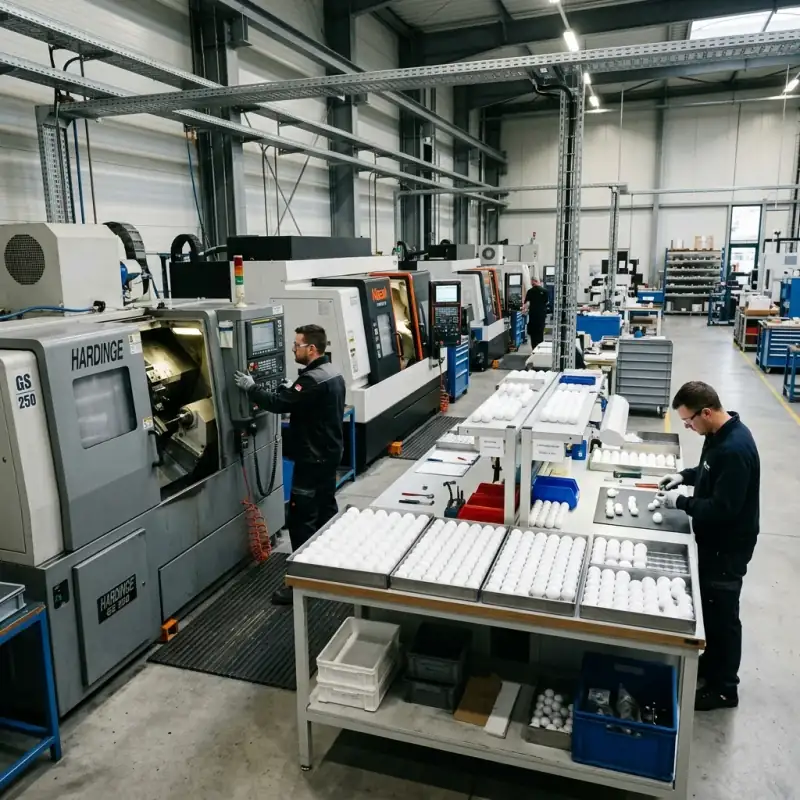
Summary:Polypropylene balls have a density of roughly 0.90 g/cm³ — they float in water — and cost far less than PTFE, whose density of 2.14–2.20 g/cm³ means solid PTFE balls sink. PP handles many acids, alkalis and aqueous solutions well up to about 100°C. PTFE handles essentially all chemistry up to 260°C. The choice usually turns on buoyancy, temperature and budget rather than on chemical resistance alone.
Quick Answer
Polypropylene balls float and cost a fraction of PTFE. PTFE handles chemistry and temperature that PP cannot approach. PP's density of ~0.90 g/cm³ puts it below water, making it the default for float duty; solid PTFE at 2.14–2.20 g/cm³ sinks, which is why buoyant PTFE applications use hollow balls instead.
Head-to-Head
| Property | PTFE | Polypropylene (PP) |
|---|---|---|
| Density | 2.14–2.20 g/cm³ (sinks) | ~0.90 g/cm³ (floats) |
| Continuous service temperature | -200°C to +260°C | 0°C to ~+100°C |
| Low temperature limit | -200°C | Becomes brittle below ~0°C |
| Chemical resistance | Near-universal | Good to acids, alkalis, salts; poor to oxidisers and aromatic/chlorinated solvents |
| Coefficient of friction | 0.04–0.10 | 0.25–0.35 |
| Tensile strength | ~20–35 MPa | ~30–40 MPa |
| Water absorption | < 0.01% | < 0.02% |
| Relative cost | Highest of the two | Lowest cost polymer ball in common use |
Buoyancy — the Usual Deciding Factor
Most PP versus PTFE decisions come down to whether the ball needs to float. PP floats in water naturally and requires no special construction, which makes it the standard choice for tank float valves, level indicators, sight glasses and float switches in aqueous service.
Solid PTFE sinks. Where an application needs both buoyancy and PTFE's chemical resistance — a float in hot acid, for instance — the answer is a hollow PTFE ball, made from two machined hemispheres joined by thermal fusion and chemical welding. That gives buoyancy while retaining full PTFE capability, at higher cost than either solid PTFE or PP.
Where PP Is the Right Choice
- Float and level duty in water or mild aqueous chemistry. The classic PP application.
- Water and effluent treatment. PP handles most treatment chemistry at ambient temperature.
- Cost-sensitive high-volume use. PP is the cheapest common polymer ball by a clear margin.
- Dilute acid and alkali service below 100°C. Adequate, and specifying PTFE here is overspending.
Where PTFE Is the Right Choice
- Above about 100°C. PP softens and deforms; PTFE runs to 260°C.
- Below 0°C. PP embrittles and cracks; PTFE stays serviceable to -200°C.
- Strong oxidisers, aromatic or chlorinated solvents. These attack PP.
- Concentrated acids at temperature. PP's resistance falls away as temperature rises.
- Very low friction requirements. PP's friction coefficient is several times PTFE's.
A Common Mistake
Specifying PP because it "handles chemicals" without checking temperature. PP's chemical resistance data is usually quoted at ambient, and it degrades significantly as temperature rises — a PP ball that is fine in 30% sulphuric acid at 20°C may fail in the same acid at 70°C. If your service is warm and chemical, check both variables together rather than reading the chemical table alone.
We manufacture PP balls, solid PTFE balls and hollow PTFE balls, so tell us the media, the temperature and whether it needs to float, and we will recommend the one that fits rather than the one that costs most.
Related Reading
- PP Balls — product specifications
- PTFE Hollow Balls — buoyancy with full chemical resistance
- Engineering Plastic Balls
- PTFE Material Properties
- PTFE Ball Selection Guide
PTFE vs Polypropylene Balls — FAQ
Do polypropylene balls float?
Yes. PP has a density around 0.90 g/cm³, below water’s 1.0, so solid PP balls float naturally. That makes them the default choice for level float and tank indication duty. Solid PTFE at 2.14–2.20 g/cm³ sinks, which is why buoyant PTFE applications use hollow PTFE balls made from welded hemispheres instead.
When is PP the better choice?
When you need buoyancy, when the media is aqueous and moderate, when temperature stays below about 100°C, and when cost matters. In those conditions PP does the job at a fraction of PTFE’s price and specifying PTFE is simply overspending.
Is polypropylene chemically resistant enough?
For a lot of duty, yes. PP resists most acids, alkalis, salts and aqueous solutions well and is widely used in water treatment and mild chemical service. It is attacked by strong oxidisers, chlorinated and aromatic solvents, and its ceiling is roughly 100°C. Where any of those apply, PTFE is the answer.
Can I use PP balls for a float in hot chemical service?
Usually not. PP softens well before 100°C and is attacked by oxidisers and aromatic solvents. For a buoyant element in hot or aggressive chemistry, a hollow PTFE ball is the correct solution — it floats while retaining full PTFE chemical and temperature capability.
Request a PTFE Ball Quote
Tell us the ball diameter (5 mm to 310 mm), material grade, quantity, and application. In-house PTFE ball manufacturer & OEM — Dahegam, Gandhinagar, Gujarat, India.
- Response within 24 hours on business days
- MOQ flexible — samples and OEM volumes
- Engineering drawings accepted
- Export supply worldwide
- Metric and inch sizes from 5 mm to 310 mm
224/1, Nr. Precision Autowares, Nr. IOCL Petrol Pump, Zak-Vahelal Road, Dahegam
Gandhinagar, Gujarat 382305
India