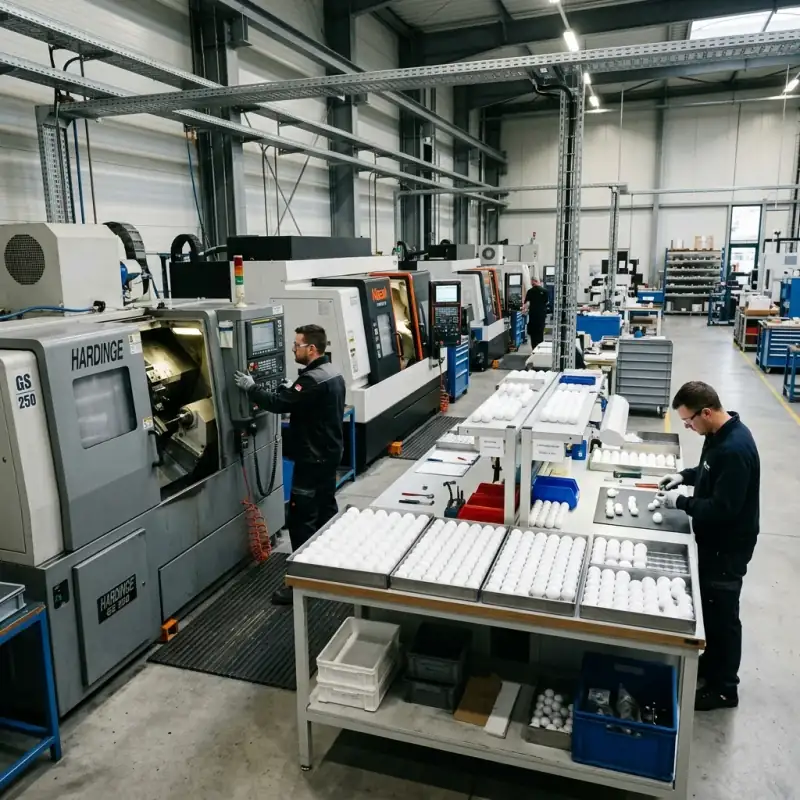
Summary:PTFE offers wider chemical resistance and far lower friction; PEEK offers dramatically higher mechanical strength, better wear resistance and a higher continuous temperature limit (around 250°C, with much better load capability at temperature). Choose PTFE when chemical breadth and low friction govern. Choose PEEK when the sphere must carry mechanical load, resist deformation or survive high pressure — the failure modes where PTFE cold-flows.
Quick Answer
Choose PTFE when chemical breadth and low friction govern. Choose PEEK when the ball must carry mechanical load, resist deformation, or survive high pressure at temperature. PEEK costs several times more per piece, but in load-bearing duty where PTFE cold-flows, it frequently costs less per operating hour.
Head-to-Head
| Property | PTFE | PEEK |
|---|---|---|
| Continuous service temperature | -200°C to +260°C | -60°C to +250°C |
| Strength at temperature | Drops sharply; cold flow accelerates | Retains strength well to 250°C |
| Tensile strength | ~20–35 MPa | ~90–100 MPa |
| Compressive strength | Low | High |
| Cold flow / creep | Significant | Minimal |
| Coefficient of friction | 0.04–0.10 (lowest of any solid) | 0.30–0.40 |
| Wear resistance | Poor | Excellent |
| Chemical resistance | Near-universal | Broad, but attacked by concentrated sulphuric acid |
| Density | 2.14–2.20 g/cm³ | ~1.32 g/cm³ |
| Relative cost | Baseline | Several times higher |
Where PTFE Wins
- Aggressive chemistry. Concentrated sulphuric acid and certain halogenated compounds attack PEEK; PTFE is unaffected.
- Low-friction duty. PTFE's friction coefficient is roughly a quarter of PEEK's, and it does not stick-slip — critical in low-velocity movement.
- Cryogenic service. PTFE remains serviceable to around -200°C; PEEK is limited to about -60°C.
- Food and pharmaceutical contact. Virgin PTFE is the established, well-documented choice.
- Cost. Where the duty does not demand PEEK's strength, specifying it is simply overspending.
Where PEEK Wins
- High seat load or system pressure. PEEK does not cold-flow into the seat the way PTFE does.
- High-cycle duty. Far better wear resistance means longer replacement intervals.
- Load at temperature. PTFE softens as temperature rises; PEEK holds its mechanical properties.
- Dimensional stability. Lower thermal expansion means fits stay predictable across the operating range.
- Weight-sensitive assemblies. PEEK is around 40% lighter than PTFE.
How to Decide
Look at how your current ball fails. That single observation resolves most of these decisions:
- Flattened at the seat contact, otherwise intact → cold flow. Move to filled PTFE first; if that is still insufficient, move to PEEK.
- Swollen, cracked, softened or discoloured → chemical attack. Check PEEK compatibility carefully before switching; PTFE may already be the right answer and the problem is elsewhere.
- Uniformly eroded and undersized → abrasion. PEEK will last longer, but check whether UHMWPE would do the job more cheaply.
- Intact but the valve leaks → likely a sphericity or seat problem, not a material problem. Changing material will not fix it.
A Note on Cost
PEEK's price makes buyers reject it reflexively. That is often the wrong call. If a PEEK ball runs five times as long as PTFE in a high-load pump, the material premium is offset by the maintenance interventions you no longer perform — and in continuous-process plant, the downtime avoided usually dwarfs the component cost entirely. Price the decision on cost per operating hour, not on the purchase order line.
Equally, we would rather tell you plainly that your application does not need PEEK than sell it to you. We manufacture both PTFE and PEEK balls, so we have no reason to push you toward either.
Related Reading
- PEEK Balls — product specifications
- Filled PTFE Balls — the intermediate step before PEEK
- PTFE Material Properties
- Common Failure Modes
- PTFE Ball Selection Guide
PTFE vs PEEK Balls — FAQ
Is PEEK better than PTFE?
Neither is better in general — they fail differently. PEEK is far stronger mechanically and does not cold-flow the way PTFE does, so it wins where load, pressure and wear govern. PTFE has broader chemical resistance and much lower friction, so it wins in aggressive chemistry and low-friction duty. Match the material to the failure mode you are actually seeing.
Is PEEK chemically resistant enough to replace PTFE?
For most industrial media, yes. PEEK resists a wide range of chemicals but is attacked by concentrated sulphuric acid and some halogenated compounds where PTFE is unaffected. If your process includes strong acids, check compatibility before substituting.
Which handles higher temperature, PTFE or PEEK?
On paper the continuous ratings are close — PTFE around 260°C, PEEK around 250°C. In practice PEEK is far more useful at high temperature because it retains mechanical strength there, while PTFE becomes soft and cold-flows much faster as temperature rises. If the part carries load at temperature, PEEK is the practical answer.
Why is PEEK so much more expensive?
The base polymer costs several times more than PTFE and it is harder to machine. That said, price the decision on service life rather than piece cost — if a PEEK ball outlasts several PTFE replacements in a high-load application, it is often cheaper over the maintenance cycle.
Request a PTFE Ball Quote
Tell us the ball diameter (5 mm to 310 mm), material grade, quantity, and application. In-house PTFE ball manufacturer & OEM — Dahegam, Gandhinagar, Gujarat, India.
- Response within 24 hours on business days
- MOQ flexible — samples and OEM volumes
- Engineering drawings accepted
- Export supply worldwide
- Metric and inch sizes from 5 mm to 310 mm
224/1, Nr. Precision Autowares, Nr. IOCL Petrol Pump, Zak-Vahelal Road, Dahegam
Gandhinagar, Gujarat 382305
India