Summary:Nylon (polyamide) offers higher mechanical strength, better abrasion resistance and lower cost than PTFE. PTFE offers vastly wider chemical resistance, far lower friction, a much wider temperature range, and — critically — essentially zero moisture absorption. Nylon absorbs water and swells measurably, changing diameter in service, which disqualifies it from precision fits in wet duty regardless of its mechanical advantages.
Quick Answer
Nylon is stronger, harder-wearing and cheaper than PTFE — but it absorbs moisture and swells, which changes its diameter in service. Use nylon for dry or oil-wetted mechanical duty at moderate temperature. Use PTFE wherever chemistry, temperature or dimensional stability in wet service matters.
Head-to-Head
| Property | PTFE | Nylon (Polyamide) |
|---|---|---|
| Continuous service temperature | -200°C to +260°C | -40°C to ~+100°C |
| Water absorption | < 0.01% | 1.5–3% (swells measurably) |
| Dimensional stability in wet service | Excellent | Poor — diameter grows with moisture uptake |
| Tensile strength | ~20–35 MPa | ~70–85 MPa |
| Abrasion resistance | Poor | Good |
| Coefficient of friction | 0.04–0.10 | 0.20–0.35 |
| Acid resistance | Excellent | Poor — attacked even by dilute acids over time |
| Density | 2.14–2.20 g/cm³ | ~1.14 g/cm³ |
| Relative cost | Higher | Lower |
The Moisture Problem
This is the point most often missed when nylon is substituted for PTFE to save cost. Nylon is hygroscopic — it absorbs water from both the atmosphere and the process fluid, and it swells as it does so. A nylon ball measured to specification when dry will be measurably larger after weeks in a wet line, and it also becomes softer and less stiff as it takes up moisture.
In a precision fit this is disqualifying. A check ball that grows can bind in its cage or stop seating correctly, and the failure appears gradually over weeks — which makes it hard to attribute to the material. PTFE absorbs under 0.01% water and simply does not do this.
Where Nylon Is the Right Choice
- Dry mechanical duty. Pneumatic circuits, mechanical linkages, dry check valves.
- Oil-wetted assemblies. Nylon handles oils and greases well and does not absorb them.
- Load-bearing applications. Roughly three times PTFE's tensile strength and far better creep resistance.
- Cost-sensitive high-volume builds. Where media and temperature are benign, nylon does the job for less.
Where PTFE Is the Right Choice
- Any acid service. Nylon is attacked by acids including dilute ones over time.
- Wet or aqueous duty where dimensions matter. The swelling problem above.
- Above about 100°C. Nylon loses stiffness well before its stated limit.
- Solvent exposure. Nylon is attacked by phenols, some alcohols and strong oxidisers.
- Food and pharmaceutical contact. Virgin PTFE is the established specification.
- Very low friction. PTFE's coefficient is a fraction of nylon's, with no stick-slip.
A Practical Middle Ground
If nylon's mechanical properties appeal but its chemistry does not, Delrin (POM/acetal) is usually the better comparison to make. Acetal has similar strength to nylon, far lower moisture absorption, and better dimensional stability — while still costing well below PTFE. It is a common and sensible substitution for mechanical check valve duty in non-aggressive media.
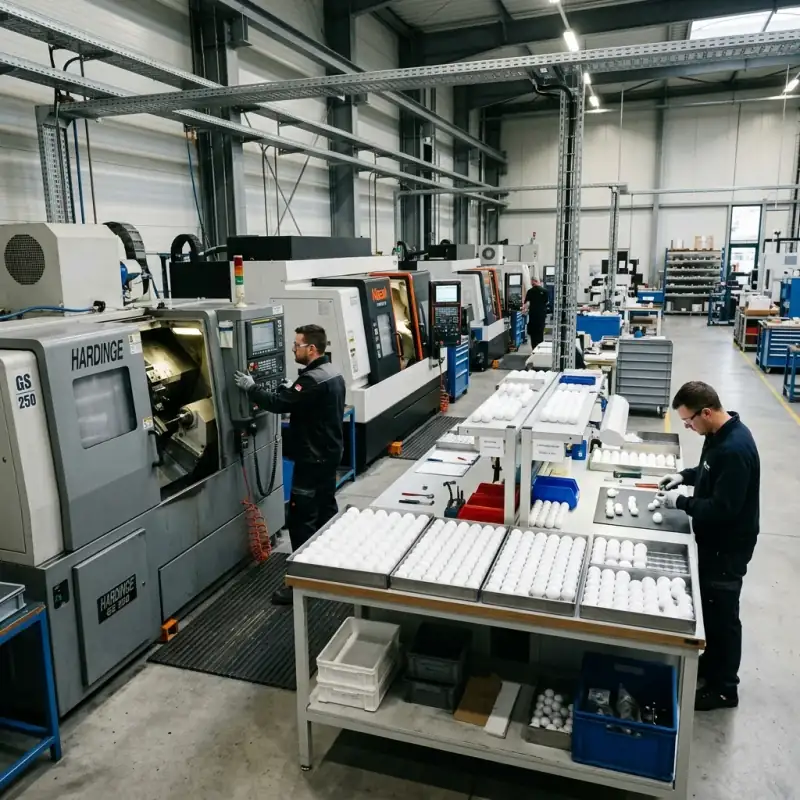
We manufacture nylon, Delrin and PTFE balls, so tell us the media, temperature and whether the line is wet, and we will point you at the one that actually fits.
Related Reading
- Nylon Balls — product specifications
- Delrin (POM) Balls — the usual better alternative
- Delrin vs PTFE
- Engineering Plastic Balls
- PTFE Ball Selection Guide
PTFE vs Nylon Balls — FAQ
Does nylon really change size in service?
Yes, and it is the most commonly underestimated problem with nylon balls. Nylon absorbs moisture from air and from the process fluid, and swells as it does so — enough to change a precision fit. A nylon ball measured dry will not be the same size after weeks in a wet line. PTFE absorbs under 0.01% water and is dimensionally stable.
When should I choose nylon over PTFE?
In dry or oil-wetted mechanical duty at moderate temperature where the media is not aggressive and cost matters — pneumatic circuits, mechanical check valves, lubricated assemblies. In those conditions nylon is stronger, harder-wearing and cheaper, and the moisture issue does not arise.
Is nylon chemically resistant?
Moderately. Nylon handles many oils, fuels, alkalis and hydrocarbons well but is attacked by acids — even dilute ones over time — and by strong oxidisers and some alcohols. PTFE resists essentially everything, so in chemical service the comparison is not close.
Which handles higher temperature?
PTFE, by a substantial margin — roughly 260°C continuous versus about 100°C for most nylon grades. Nylon also loses stiffness well before its temperature limit, so its usable working range is narrower still.
Request a PTFE Ball Quote
Tell us the ball diameter (5 mm to 310 mm), material grade, quantity, and application. In-house PTFE ball manufacturer & OEM — Dahegam, Gandhinagar, Gujarat, India.
- Response within 24 hours on business days
- MOQ flexible — samples and OEM volumes
- Engineering drawings accepted
- Export supply worldwide
- Metric and inch sizes from 5 mm to 310 mm
224/1, Nr. Precision Autowares, Nr. IOCL Petrol Pump, Zak-Vahelal Road, Dahegam
Gandhinagar, Gujarat 382305
India