The Short Answer
Verify the supplier manufactures rather than trades, fix the Incoterm before comparing quotes, specify documentation up front, and plan around realistic transit. Get those four right and importing PTFE balls from India is straightforward.
1. Manufacturer or Trader?
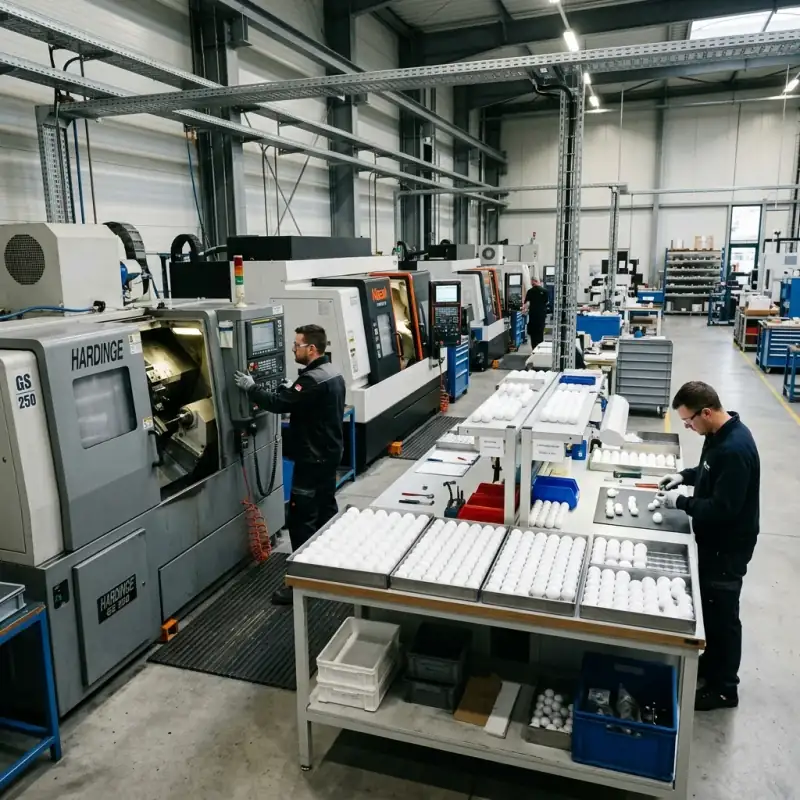
This is the question that matters most and is asked least. India has many PTFE ball suppliers and considerably fewer PTFE ball manufacturers. A trader buys from whichever producer is cheapest that month, which means the resin grade, sintering cycle and finishing method behind your consignment can change between orders without anyone telling you.
Ways to tell:
- Ask which stages happen in their plant. A manufacturer answers specifically — compaction pressure, sintering ramp, whether grinding is in-house. A trader answers in generalities.
- Ask what happens with the die for a custom diameter. A manufacturer fabricates and retains it. A trader has to ask someone else.
- Ask for a video call from the shop floor. Reasonable, cheap, and immediately conclusive.
- Ask about the largest diameter they can produce. Void-free large PTFE spheres require real process control. It is a good capability probe.
2. Fix the Incoterm First
Quotations on different Incoterms are not comparable, and this is where import buyers most often mislead themselves. The common terms for ball shipments:
- EXW — you collect from the factory. Cheapest headline number, most work for you.
- FOB — supplier delivers to the Indian port and clears export. You handle sea freight onward.
- CFR — supplier pays sea freight to your port. You handle insurance and import clearance.
- CIF — as CFR plus insurance.
Ask every supplier for the same term. An EXW quote will always look cheaper than a CIF one for the identical goods.
3. Ports and Transit
Most PTFE ball exports leave from Mundra or Nhava Sheva on the west coast. Realistic port-to-port sea transit, before clearance:
| Destination | Typical sea transit |
|---|---|
| UAE, Oman, Qatar | 5–10 days |
| Saudi Arabia | 8–14 days |
| Sri Lanka, Bangladesh | 5–12 days |
| Southeast Asia | 10–20 days |
| East Africa | 12–18 days |
| Europe / UK | 20–30 days |
| United States | 25–40 days |
| Brazil | 30–45 days |
Add production time before this — typically one to two weeks for standard diameters, longer if tooling is needed. For long-haul destinations, air freight is genuinely viable for balls because they are small and light relative to their value.
4. Documentation — Specify Before Production
Standard export documents are commercial invoice, packing list and certificate of origin. Anything beyond that must be agreed before production, not requested after the goods are packed:
- Material declaration confirming virgin resin
- Food-contact compliance statement, where relevant
- Dimensional inspection report
- Any certificate your customs authority or end client mandates
Retrospective documentation is where import deals go wrong. Put the list in the purchase order.
5. Sensible First-Order Practice
- Order samples first. Air freight a small quantity, measure it yourself against your specification, run it in the actual application.
- Send a drawing, not a description. "12 mm PTFE ball" leaves tolerance, grade and finish undefined — three of the five things that determine price and performance.
- Agree payment terms explicitly. Advance, letter of credit or a split are all normal for a first order.
- Consolidate sizes into one shipment. Freight is a real component of landed cost, and mixed consignments share it.
- Plan for the transit. Reactive ordering does not work at 30 days' transit. Size orders to your replacement schedule.