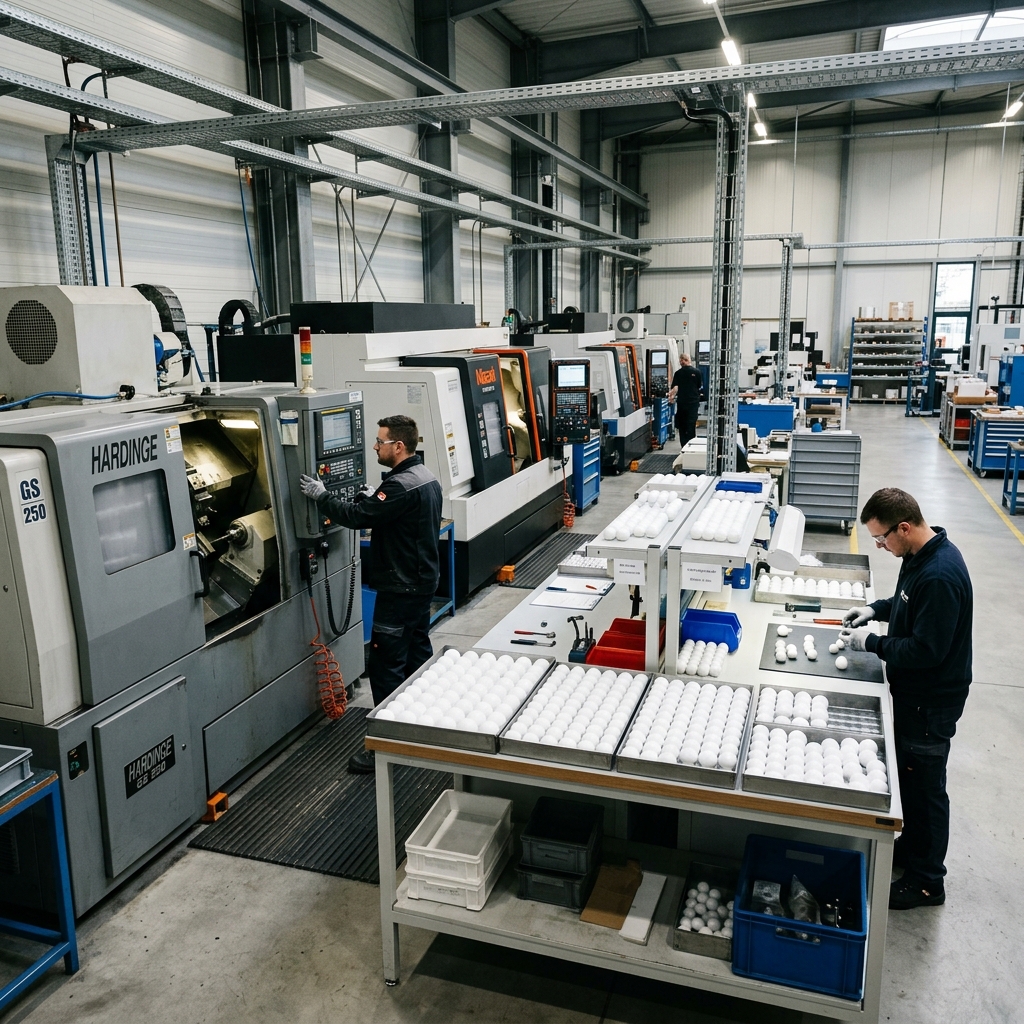
What is a Carbon-Filled PTFE Ball?
Carbon-filled PTFE (polytetrafluoroethylene) is formulated by blending high-purity carbon coke powder or carbon fibers into the base PTFE resin, typically at a loading of 25% by weight. At Hemsun Engg. Industries, we do not machine spheres from pre-bought plastic rods; we compound premium raw materials—using SRF Flonio 120/210 and GFL Inoflon 610 base resins—with 25% carbon coke in-house and mold our own custom billets, rods, and bushes. The preforms are compressed at calculated compaction pressures of up to 60 MPa in custom presses and dies fabricated in our own toolroom, followed by oven sintering under strictly calculated thermal curves. This calculations-driven approach guarantees absolute material quality, meeting target datasheet properties, strict machining tolerances, and surface roughness required for leak-free B2B industrial valves, check valves, and slurry pumps.
Performance Advantages of Carbon Filled Grade
- Anti-Static & Conductive: Eliminates static charge build-up, satisfying explosive safety criteria.
- Universal HF Acid Resistance: Chemically compatible with hydrofluoric (HF) acid and hot caustic solutions where glass fillers degrade.
- Enhanced Load Capacity: Higher wear resistance and lower deformation under heavy seat loads.
- Heat Dissipation: Superior thermal conductivity reduces local heat build-up under rapid valve cycle rates.
Carbon Filled Specs
Carbon Filled PTFE vs Glass & Bronze Grades
Understand how carbon-filled fluoropolymers rank against other common filler combinations in terms of conductivity and chemical compatibility.
| Parameter | Virgin PTFE | Carbon-Filled PTFE (25%) | Glass-Filled PTFE (25%) | Bronze-Filled PTFE (60%) |
|---|---|---|---|---|
| Electrical Conductivity | Insulator (10¹⁸ Ohm) | Conductive (10⁴ Ohm) | Insulator (10¹⁶ Ohm) | Semi-conductive |
| Wear Resistance | Low | High | Very High | Excellent |
| Hydrofluoric (HF) Acid | Compatible | Fully Compatible | Attacked (Glass Dissolves) | Attacked (Bronze Etches) |
| Thermal Conductivity | 0.24 W/m·K | 0.45 – 0.50 W/m·K | 0.37 W/m·K | 0.65 – 0.80 W/m·K |
| Deformation Under Load | High (10%) | Very Low (2.5%) | Low (3.5%) | Extremely Low (1.5%) |
| Coefficient of Friction | 0.04 | 0.11 | 0.09 | 0.13 |
Where Conductive PTFE Balls are Utilized
Industries dealing with flammable fluids, aggressive acids, and friction heating utilize carbon-filled fluoropolymer check spheres.
Petrochemical & Fuel Lines
Anti-static check valves and relief spheres in fuel depots, chemical tankers, and petroleum transport lines where static sparks must be prevented.
HF Acid Pipelines
Chemical processing valves containing hydrofluoric acid or hot caustic soda where standard glass-filled PTFE would deteriorate.
High Cycle Steam Valves
Sealing valves subject to continuous high-temperature steam pulses, benefiting from carbon's higher thermal conductivity to dissipate localized heat.
Submerged Fluid Pumps
Industrial check valves operating continuously in water, organic solvents, or industrial lubricants where low friction and long wear life are required.
Carbon Filled PTFE Ball Size Selection (6 mm to 310 mm)
We manufacture solid carbon-filled spheres in metric and fractional inch standards. Non-standard diameters are custom machined.
| Metric Diameter (mm) | Imperial Diameter (Inch) | Electrical Status | Standard Sizing Tolerance | Availability |
|---|---|---|---|---|
| 6.00 mm | 1/4″ | Conductive / Antistatic | ±0.05 mm | Stock / Made-to-Order |
| 9.52 mm | 3/8″ | Conductive / Antistatic | ±0.05 mm | Stock / Made-to-Order |
| 12.70 mm | 1/2″ | Conductive / Antistatic | ±0.08 mm | Stock / Made-to-Order |
| 19.05 mm | 3/4″ | Conductive / Antistatic | ±0.08 mm | Stock / Made-to-Order |
| 25.40 mm | 1″ | Conductive / Antistatic | ±0.10 mm | Stock / Made-to-Order |
| 38.10 mm | 1-1/2″ | Conductive / Antistatic | ±0.15 mm | OEM Batch Sintering |
| 50.80 mm | 2″ | Conductive / Antistatic | ±0.15 mm | OEM Batch Sintering |
| 76.20 mm | 3″ | Conductive / Antistatic | ±0.20 mm | Custom Machining |
| 100.00 mm | 4″ | Conductive / Antistatic | ±0.25 mm | Custom Machining |
| 150.00 mm | 6″ | Conductive / Antistatic | ±0.30 mm | Custom Machining |
| 310.00 mm | 12.2″ | Conductive / Antistatic | ±0.50 mm | Heavy Custom CNC |
Carbon Filled PTFE Balls FAQ
Technical answers for engineers selecting conductive and anti-static valve components.
Why use carbon filled PTFE instead of glass filled PTFE in acid lines?
Glass-filled PTFE offers excellent strength, but glass fibers are rapidly attacked by Hydrofluoric (HF) acid and strong hot alkalis. Carbon filler is completely inert to these chemicals, making it the standard choice for HF chemical valves.
Does the carbon filler bleed out or contaminate the fluid path?
No. During compression molding and high-temperature sintering, the carbon particles are bound within the dense PTFE matrix. The material remains highly stable and does not release particles under normal flow conditions, although it is not recommended for high-purity biopharma lines.
What is the difference between carbon-filled and carbon-fiber-reinforced PTFE?
Carbon-filled PTFE typically uses carbon coke powder (enhancing conductivity and wear resistance). Carbon-fiber PTFE utilizes short-cut carbon fibers, which further increases tensile strength and reduces thermal expansion but is slightly more abrasive to metal seats.
Do anti-static carbon PTFE spheres wear out matching seats?
Carbon filler is much less abrasive than glass or bronze fillers. It is generally compatible with standard stainless steel and hard plastic valve seats, offering low friction and smooth sliding cycles.
Request B2B Quote
Direct factory pricing on carbon-filled PTFE balls. Submit your size, loading specifications, quantity, and destination for a quote.
- Response within 24 hours on business days
- MOQ flexible — samples and OEM volumes
- Engineering drawings accepted
- Export supply worldwide
- Metric and inch sizes from 6 mm to 310 mm
224/1, Zak-Vahelal Road, Dahegam
Gandhinagar, Gujarat 382305
India